
A gas fireplace that will not light, lights and dies, or heats weakly usually comes down to a small handful of failures: a dead pilot, a thermocouple that stopped holding the valve open, or a gas supply that never arrived. Gas fireplace repair Harbor City technicians perform most often is exactly that — small parts, careful testing, done right.
Pacific Fireside services gas fireplaces across Harbor City and the South Bay. One warning up front: if you smell gas, skip the troubleshooting — leave the house and call from outside. Shut the gas off only if you know the procedure.
Gas fireplace trouble in Harbor City? Here is how the repair call usually goes
Most service calls start the same way: the remote blinks, the wall switch does nothing, and the firebox that worked last winter sits cold. Maybe there is a click with no whoosh; maybe the flame catches and dies when you release the knob. Each symptom points somewhere specific, and a tech who has seen a few hundred of them narrows it fast.
A dead pilot assembly is the number-one find — dust, a heat-thinned thermocouple, or a pilot orifice choked with carbon. Next is gas supply: not a city-wide outage, but a closed service valve behind an access panel or a seismic shutoff tripped by a tremor. Then the control side: a weak thermopile, a tripped safety switch, or a remote receiver that lost sync. Pilot light repair fireplace Wilmington calls usually turn out to be this same sequence — the pilot was the symptom, not the whole story.
We never guess and swap parts. The repair order is fixed: confirm the symptom, test gas flow, check electrical generation, inspect the venting path, then repair. That order matters — a fireplace with a good pilot and a blocked termination is more dangerous than one that simply will not light.
Why Harbor City homes call for gas fireplace service
Mid-century ranch and bungalow homes along Vermont and the blocks off Anaheim often carry vent-free or direct-vent gas log sets installed during nineties and early-2000s remodels. Those units are now twenty-plus years old — exactly when pilots get finicky and millivolt valves drift. A gas log fireplace service Harbor City visit on an older home often finds a unit that has quietly outlasted its controls.
Marine air adds its own wear. Salt-tinged breeze works into outdoor vent terminations and the metal around factory-built chases. We see corroded termination caps and vent connections that look fine from the yard but leak at the joints — which explains intermittent performance and the faint smell on windy days. And a fireplace that dies the same week as a tremor usually isn’t broken: the seismic shutoff tripped and needs a deliberate restart, not a parts order.
Dust finishes the picture. Gas fireplace pilot assemblies breathe room air, and a year’s worth of dust on a pilot hood and burner ports is enough to starve the flame. This is why an annual gas fireplace maintenance San Pedro or Harbor City appointment, not a wait-until-it-dies approach, catches most failures before the first cold night you actually need the fire.
The failures we find most: pilot lights, thermocouples, valves, and venting
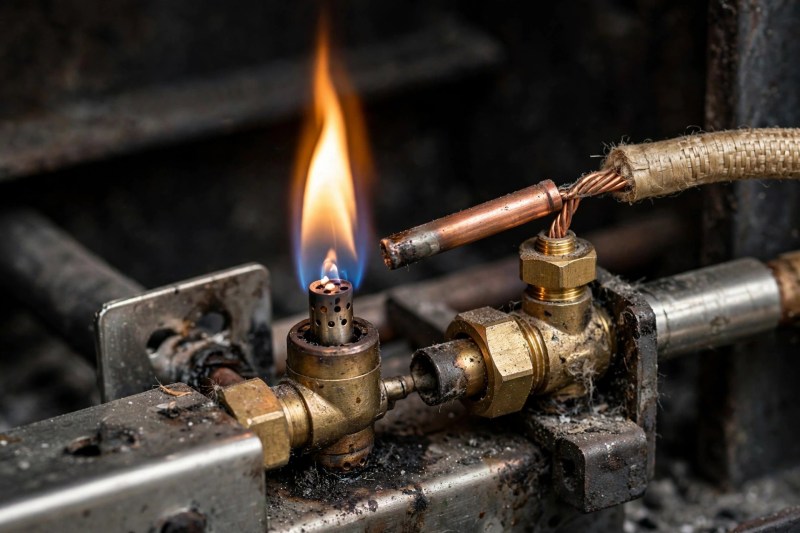
Pilot assemblies fail first because they do everything: sense the flame, generate the electricity that holds the gas valve open, and tolerate heat cycles for decades. A heat-thinned thermocouple generates weak voltage — the pilot lights while you hold the knob and drops the moment you release it. That is the classic thermocouple signature, and it is a replaceable part, not a reason to replace the fireplace.
Burner and orifice fouling comes next. Carbon crusts the main burner ports, the flame turns taller and yellower, and the glass soots at the edges. Heavy soot signals incomplete combustion — a carbon monoxide risk until the burner is cleaned and the air shutter set right.
Gas valves fail more subtly. Millivolt valves either hold or they do not, and a thermopile reading under spec cannot open one no matter how clean the pilot is. We measure millivolt output on every no-heat call. On electronic-ignition units, the story shifts to flame sensors that need cleaning and modules that lock out after repeated failed starts.
Venting rounds out the list and causes the most confusion. Direct-vent units breathe through a coaxial pipe: exhaust out the middle, fresh air in around it. When the outer pipe separates at a joint — corrosion, a loose clamp, a settled chase — the unit pulls its own exhaust back in. Performance gets weird, glass soils fast, and the safety switch may drop the unit out. A visual vent check from the termination inward is part of every repair, not an add-on. See our fireplace repair services for the full scope of what a service visit covers.
What a gas fireplace repair visit includes, step by step
It starts with the symptom interview: what happened, in what order, and whether anything changed — a remodel, an earthquake, a plumber who touched the gas line. Then gas-supply confirmation: service valve open, seismic valve reset correctly, pressure checked at the fireplace. Electrical generation gets tested next — pilot lit, thermocouple and thermopile readings checked against the valve’s minimum. Only then do we look at controls, remotes, and wall switches, because chasing a “bad remote” when the thermopile is weak wastes money.
After the repair, the unit runs a full cycle. The flame pattern gets watched, not glanced at — stable, blue at the base with natural yellow tips, not sooting and not lifting off the burner. The glass goes back on, the unit runs at full output for a sustained stretch, and the outside termination gets a final check.
The checks that happen before any wrench turns
First, we rule out a gas leak and combustion spill into the room. A combustible-gas detector sweep around the valve, fittings, and the gas line entry into the firebox takes a minute and stops the call cold if something shows up. Venting gets an eyes-on pass from the outside termination where accessible. If the glass is sooted, we read the soot like a chart — edges only means one thing, whole-pane soot means another.
What we test after the fix
The tests are performance-based, not parts-based. Millivolt readings get confirmed under load. The wall switch and remote each cycle the unit through start, run, and shutdown. Safety spill switches get tripped on purpose where the design allows, to confirm they actually cut the gas. We check for gas smell while the unit runs, and confirm the room’s CO alarm is present and working. Our blog on fireplace care covers seasonal checklists for the months between service visits.
Safety differences between gas and wood-burning systems
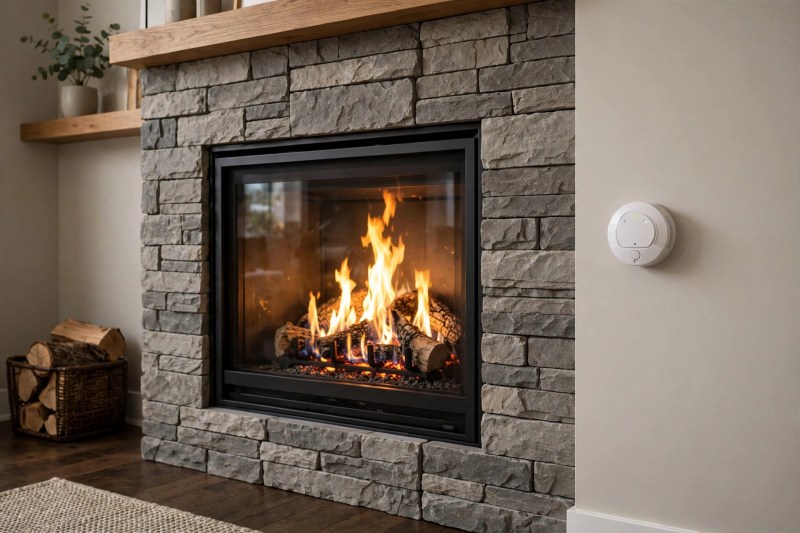
Gas fireplaces get underestimated because there is no axe, no kindling, no chimney-fire drama. The risks are real but quieter. Carbon monoxide is the headline: colorless, odorless, produced by any poorly vented combustion appliance. Working CO alarms on every floor, especially outside sleeping areas, are non-negotiable in a home with gas fireplaces. Test them when you test the smoke alarms.
Natural gas is odorized with mercaptan — the rotten-egg smell — and that is your best early warning. If you catch it near the fireplace, treat it as a gas event, not a fireplace event: do not flip switches or light the unit to “see if it clears.” Shut off the supply valve if it is accessible and you know the procedure, leave the home, and call your gas utility or emergency line from outside. This is the one scenario where patience is dangerous.
Wood systems fail visibly — creosote glazes the flue, you see it, you schedule a sweep. Gas systems fail electrically and mechanically, inside sealed compartments: a gas fireplace can look spotless behind the glass while a vent joint loosens or a thermocouple weakens. For authoritative background on venting and combustion safety, the National Fire Protection Association publishes the codes most gas appliance work references. Gas does have one genuine advantage: no creosote, no chimney-fire risk, no sparks on a dry roof. Annual service on a gas unit is about controls, combustion air, and vent integrity — a different checklist than a sweep, not a shorter one.
FAQs about gas fireplace repair in Harbor City
Why does my pilot light go out every time I release the knob?
Almost always a weak thermocouple or a dirty pilot assembly. The thermocouple must be hot enough to generate the millivoltage that holds the gas valve open; when it cannot, the valve drops the instant you release. Cleaning the pilot and replacing the thermocouple fixes it in most cases. If it still will not hold, the valve or the pilot gas supply is next in line.
Can I relight the pilot myself?
Most homeowners can, following the label inside the access panel — typically a knob sequence with a timed hold. The line is drawn at anything beyond a clean relight: if the pilot will not stay lit after two tries, if you smell gas, or if the unit needs tools opened up, that is a service call. Repeated relighting on a unit with a real fault just cycles raw gas through the firebox.
My fireplace starts but shuts off after a few minutes. What is that?
Usually a safety limit being hit. On millivolt systems, a fading thermopile cannot hold the valve under load. On electronic-ignition units, a dirty flame sensor loses the flame signal and the module locks out. Blocked venting can also trip spill switches. Since several faults produce the same symptom, this one deserves diagnosis, not a parts guess — a tech measures electrical output first and works backward.
How much of the repair can wait until the annual service?
Gas smell, sooting glass, water entry into the firebox, or a unit that died after an earthquake should not wait. A pilot that will not stay lit is a now-problem if you are heading into the season you use the fireplace. Cosmetic issues — a shifted log, a remote with a dying battery — can ride along to the next visit. When in doubt, contact us and describe the symptom; we will tell you honestly whether it is urgent.
When a Harbor City gas fireplace needs a professional, call the number below
Gas fireplace repair in Harbor City is mostly a story of small parts and careful testing: pilots, thermocouples, thermopiles, valves, and the venting that ties them together. The pattern that keeps systems healthy is simple — annual service before the season, quick attention when symptoms change, and a gas smell treated as an emergency. Pacific Fireside is a licensed contractor, California License #1105265, and our techs run the full diagnostic sequence above on every gas fireplace call.
If your unit will not light, lights and dies, or is sooting up the glass, reach us at our Harbor City office: 24404 S Vermont Avenue, Suite 307C, Harbor City, CA 90710. Call 562-222-3249 to schedule gas fireplace repair Harbor City service in Harbor City, Torrance, Wilmington, or San Pedro — and go into the season with a fireplace that lights when you ask it to.


